
WiFi Speed Vs Internet Speed
A practical guide to the difference between WiFi speed and internet speed for Australian households.
CompareUs Editorial TeamConsumer utilities editorial team
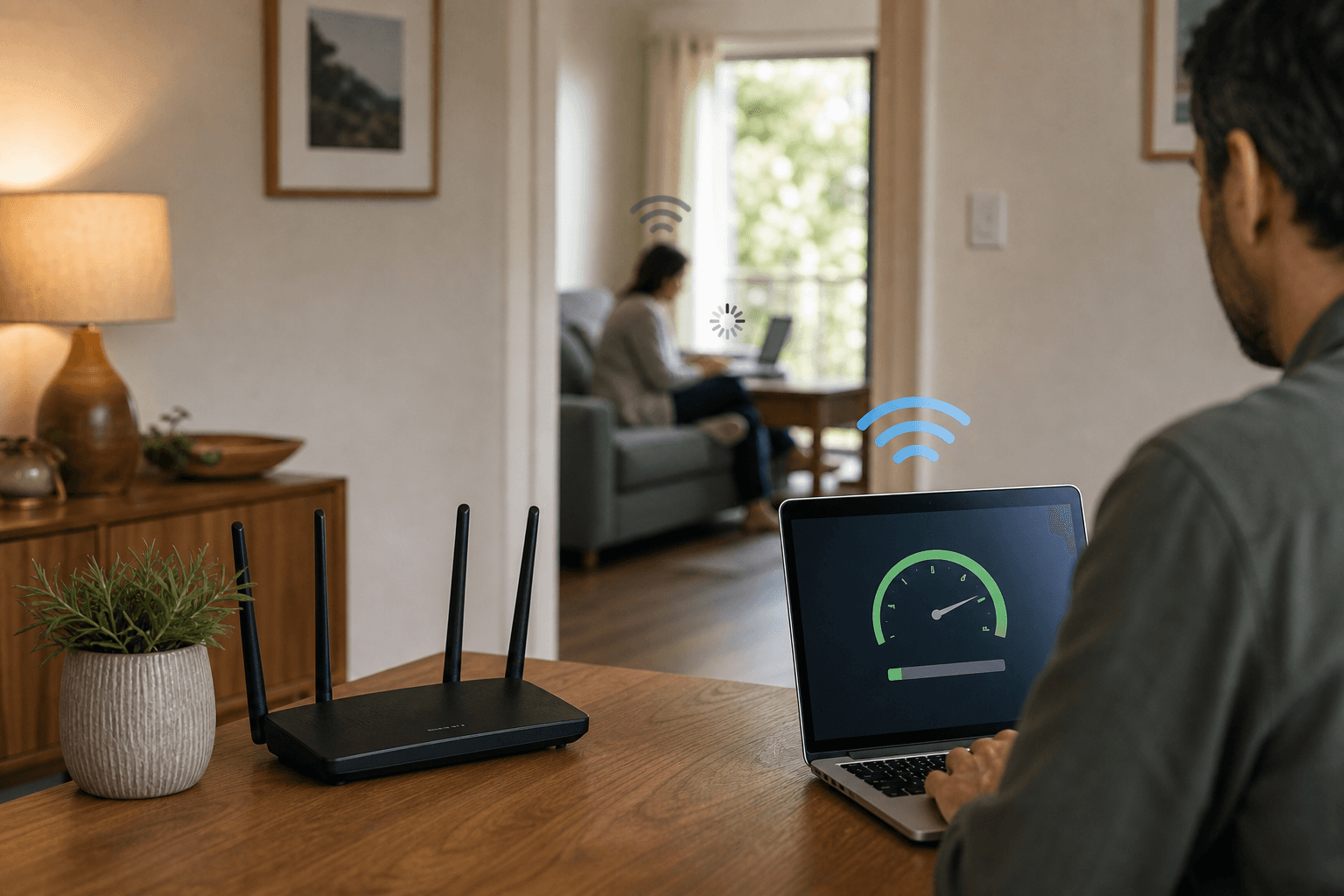
If you have ever paid for a fast internet plan and still felt disappointed, there is a good chance the problem was WiFi rather than the internet coming into the home. WiFi speed vs internet speed is one of the most useful distinctions households can learn because it changes how you troubleshoot and spend money.
What internet speed means
Internet speed is the capacity of the broadband service reaching your home. That is the part shaped by your NBN plan, your connection technology and performance conditions at the network level.
When people compare NBN 25, 50, 100 or 250, they are mainly talking about internet speed.
What WiFi speed means
WiFi speed is how well your device receives that internet over your local wireless network. It depends on:
- distance from the router;
- walls and building materials;
- interference from other devices or neighbouring networks;
- router quality and placement;
- device capability.
So a home can have strong internet speed on paper and still feel slow on a bedroom laptop because the WiFi connection is weak in that room.
Why the two get mixed up
The internet and WiFi blend together in normal use, so most people only notice the final experience. If a video buffers, they naturally think the internet is slow. But the real issue might be that the WiFi path to that device is poor.
Why Ethernet matters
A wired Ethernet test is useful because it reduces WiFi variables. If an Ethernet result looks good and WiFi looks poor, the broadband service itself may be fine. Provider setup guidance also shows that different connection and router modes matter, especially when configuring home equipment correctly.
When a faster plan helps and when it does not
A faster plan helps when the household is genuinely using more bandwidth than the current tier can comfortably support.
A faster plan does not automatically help when:
- one room has weak coverage;
- the router is badly placed;
- the device is old or limited;
- WiFi interference is the main issue.
Common mistake
The biggest mistake is buying a faster NBN plan to solve a local WiFi problem. Sometimes that masks the issue for a while, but it does not fix the underlying in-home bottleneck.
Practical takeaway
Think of internet speed as the water coming to the house and WiFi speed as how well that water reaches each tap. If the pipe into the house is fine but one tap is weak, you do not automatically need a bigger pipe. You may need a better internal setup.
Sources and methodology
This guide uses current ACCC broadband performance context, current nbn technology guidance and current provider router setup material. It focuses on practical home-network troubleshooting rather than brand-specific hardware recommendations.
Where should you go next?
FAQs
Why is my WiFi slower than Ethernet?
WiFi is affected by distance, walls, interference and device limitations, while Ethernet removes many of those variables.
Can a fast NBN plan still feel slow on WiFi?
Yes. A weak in-home wireless setup can make a strong internet plan feel much worse than it actually is.
Should I upgrade my plan or fix my WiFi first?
If the issue is local to one room or device, fix or test the WiFi first. If the whole home struggles at busy times, the plan may be too small.
What is the best way to test the difference?
Compare a test near the router or over Ethernet with a test from the room that feels slow.
Can mesh WiFi help?
It can help with coverage issues in larger or more difficult homes, but it is not a cure for every speed problem.